In the high-stakes world of digital growth, search engine optimization has become a maze of conflicting advice. Business owners and site managers are routinely bombarded with “insider secrets,” technical tricks, and expensive strategies from self-proclaimed experts who promise to decode the algorithm.
The result is often confusion, not clarity.
One consultant says you need more keywords. Another says you need more backlinks. Another says the real answer is schema, AI optimization, content velocity, technical audits, or some proprietary formula they can’t quite explain. Before long, the most important question gets buried:
Are you creating something useful for the person who is actually reading it?
That is the part SEO conversations too often forget. Search is not really about pleasing an algorithm. It is about helping a human being find a meaningful answer, a useful service, a trusted expert, or a solution to a real problem.
Google’s own documentation points back to this same principle again and again. The goal is not to trick the system. The goal is to create helpful, reliable, people-first content.
To find clarity, we are going back to the ground truth. By looking at Google’s own Search Essentials and SEO Starter Guide, we can strip away the noise and focus on what actually matters.
Here are the SEO truths that many “algorithm whisperers” would rather keep complicated.
- The E-E-A-T Ranking Factor Myth
One of the most persistent trends in modern SEO is the obsession with E-E-A-T: Experience, Expertise, Authoritativeness, and Trustworthiness.
Many consultants talk about E-E-A-T as if it is a technical score your website can raise through a checklist of tactics. They sell services designed to “boost your E-E-A-T” as though Google is assigning your site a visible grade in the background.
Google’s documentation is much more direct:
“Thinking E-E-A-T is a ranking factor. No, it’s not.”
That does not mean experience, expertise, authority, and trust do not matter. They absolutely matter. But they matter because they help people decide whether your content is worth reading, believing, and acting on.
E-E-A-T is a useful way to think about content quality. It is not a magic lever.
The better question is not, “How do we improve our E-E-A-T score?”
The better question is, “Does this page clearly show that we understand the reader’s problem and know how to help?”
That shift matters. It moves your attention away from trying to satisfy an invisible machine and back toward serving the person on the other side of the screen.
Substance is what matters. Clear explanations matter. Real experience matters. Helpful guidance matters. A reader should leave your page thinking, “They understand what I’m dealing with, and they can help me move forward.”
- You Might Not Actually Need a Professional — But You May Need a Better Process
There is a common misconception that SEO is a black box too technical for the average business owner to understand. Google’s own guidance suggests something more empowering.
Many site owners can handle important parts of SEO themselves, especially at the beginning.
Google provides tools and resources that function almost like an owner’s manual for the web. Search Console, the Google Search Central blog, the SEO Starter Guide, and the official discussion forum all give site owners a practical way to understand and improve their online presence.
According to the SEO Starter Guide, many businesses can make meaningful progress by focusing on basic, practical tasks:
- Reviewing your site structure so it is logical and easy to navigate.
- Performing keyword research to understand the words people actually use.
- Submitting a sitemap to help Google discover your URLs faster.
- Developing unique, helpful content based on your specific expertise.
That last point is the most important one.
Helpful content is not just content that contains the right keywords. It is content that helps real people understand something. It answers the questions they are already asking. It reflects their concerns, their language, their hesitation, and their goals.
This is where many businesses get stuck.
They know their work. They know their clients. They know the problems they solve. But when it comes time to turn that knowledge into articles, service pages, emails, or website copy, the writing often becomes stiff, generic, or overly optimized. It starts sounding like it was written for a search engine instead of a human being.
Blue Pen helps bridge that gap.
Our work is not about helping clients chase algorithms. It is about helping them turn their expertise into content people actually want to read. We help businesses explain what they know in a way that makes their audience feel understood. The goal is not just to publish more content. The goal is to create content that helps a potential client recognize, “This company understands my problem. They know what matters. They may be able to help me.”
That is the heart of effective digital content.
A good article does more than rank. It builds trust.
A strong service page does more than list features. It helps the reader see how their needs connect to your expertise.
A useful blog post does more than satisfy a keyword target. It gives the reader language for their own problem and confidence in your ability to solve it.
So yes, many SEO tasks are DIY-friendly. But the deeper work is not merely technical. The deeper work is strategic and human. It requires knowing who you are speaking to, what they care about, what they are trying to understand, and how your expertise can serve them.
That is where Blue Pen’s approach comes in: practical SEO, clear positioning, and content built for people first.
- The Danger of the “Number One Ranking” Guarantee
In the world of SEO services, the biggest red flag is the word “guaranteed.”
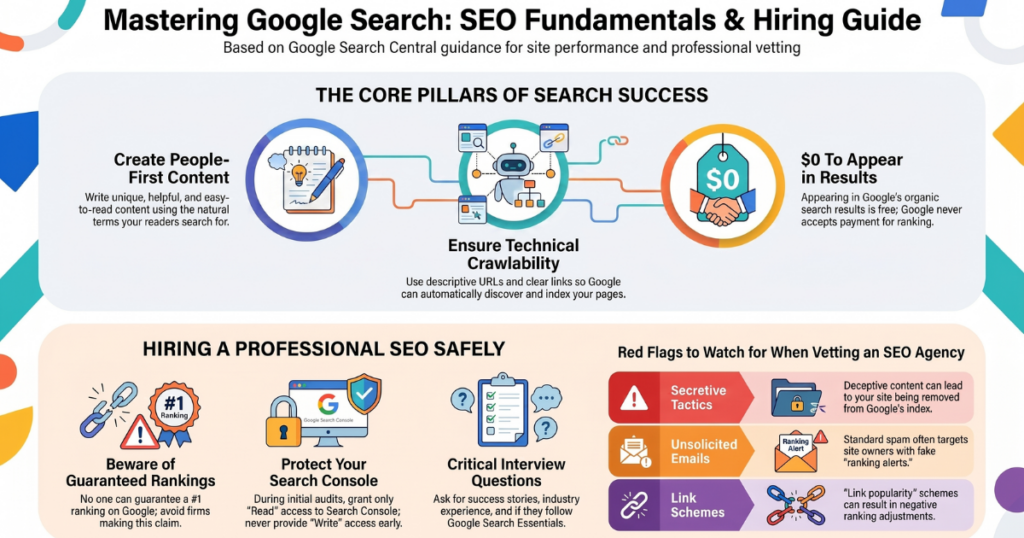
Google is clear that no one has a special relationship with them. There is no priority submission system that allows an agency to push your site to the front of the line. Any company promising guaranteed rankings should be treated with caution.
Google’s warning is direct:
“If an SEO creates deceptive or misleading content on your behalf, your site could be removed entirely from Google's index. Ultimately, you are responsible for the actions of any companies you hire.”
That last sentence matters. You are responsible for what happens on your website, even if someone else does the work.
This is another reason the “algorithm whisperer” mindset is dangerous. If an agency cannot explain what it is doing in plain language, that is a problem. If the strategy depends on tricks, shortcuts, hidden tactics, or content that misrepresents your business, it is not a strategy worth trusting.
Good SEO should be explainable.
Good content should sound like your organization.
Good strategy should make your website more useful, not less human.
If you decide to hire a professional, Google recommends asking direct questions such as:
- Do you follow the Google Search Essentials?
- What is your specific experience in my industry and my country or city?
- Will you share all the changes you make to my site and explain the reasoning behind them?
Those are not just technical questions. They are trust questions.
You are not simply hiring someone to influence rankings. You are hiring someone to help shape how your business is understood online.
- Why Technical “Semantics” Are Secondary
Many creators spend too much time obsessing over technical details that are less important than they think.
The SEO Starter Guide suggests that site owners should stop over-focusing on things like:
- Word Counts: There is no magic length. Content does not rank simply because it is long. It should be as long as it needs to be to answer the reader’s question naturally and helpfully.
- Heading Order: H1, H2, and H3 structure is important for accessibility and readability, especially for screen readers. But Google does not penalize a page simply because the heading order is imperfect.
- Meta Keywords: This is a relic of the past. Google Search does not use the keywords meta tag.
These details are not meaningless, but they are often overemphasized. They become distractions. They make writers timid. They pull attention away from the reader.
A technically perfect page that says nothing useful is not good content.
A long article stuffed with repeated keywords is not good content.
A service page written in vague marketing language is not good content.
The goal is not to write for a crawler. The goal is to communicate clearly with a person.
That person may be worried, curious, confused, comparison-shopping, researching, or ready to make a decision. Your job is to meet them there.
Search engines are trying to understand what people find useful. That means your best long-term strategy is not to sound more robotic. It is to become more genuinely helpful.
- The “Redesign” Window of Opportunity
If you do decide to hire a professional, timing matters.
Many business owners think of SEO as something to add after a website is finished. The site gets designed, the pages get built, the copy gets placed, and then someone says, “Now let’s optimize it.”
Google’s guidance suggests that SEO is most valuable much earlier in the process, especially during a redesign or the launch of a new site.
That is when the foundation is being created.
A search-friendly website is not only about keywords. It is about structure, clarity, organization, and usability. It includes a logical URL structure, clear navigation, related pages grouped in sensible ways, and a site that can be crawled and understood from the beginning.
This is also the best time to think about the human journey.
What is the visitor trying to learn?
What questions do they need answered before they trust you?
What services need their own pages?
What articles would help them understand their options?
What language do they use to describe their problem?
What proof do they need before they take the next step?
These are not merely SEO questions. They are business strategy questions.
Fixing a confusing website later is almost always harder and more expensive than building clarity into the site from the start.
Conclusion: The Long Game of Search Is Human
Search engine optimization is not a one-time fix. It is not a collection of secrets. It is not a contest to see who can most successfully manipulate a machine.
It is an ongoing process of making your website more useful, clear, trustworthy, and relevant to the people you want to reach.
Google’s documentation also reminds us to be patient. Some changes may be reflected quickly, but many SEO improvements take weeks or months to show measurable results. That is because search is a long game.
But the long game is not really about the algorithm.
The long game is about trust.
When people find your website, do they understand what you do?
Do they feel that you understand their problem?
Can they see your expertise?
Do they know what step to take next?
Do they leave with more clarity than they had before?
That is what good content does.
The best SEO strategy is not to chase every rumor, every technical trend, or every algorithm update. The best strategy is to build a website that consistently helps real people.
Write for humans first.
Use SEO to make that writing easier to find.
That is the order that matters.