Lately, I've been talking to a lot of companies that tell me they have found the greatest cheat code in SEO & GEO! They use AI to rewrite old blog posts, new blog posts in order to have an inventory of hundreds and sometimes thousands of new articles. They automate the articles, use tools like Zapier to post them to their website and they sit back hoping to see the traffic and the dollars roll in.
Then I get the call asking why this new automated content strategy isn't working. Some companies listen, while many don't want to hear the truth. My job is to be honest with you and to help navigate this new world of SEO & GEO. Please read the article, but understand that quality posts beat quantity. If you have in-house SEO and need an outside perspective, I'm here to help you. If you don't have anyone with this type of experience, feel free to contact me for a consultation.
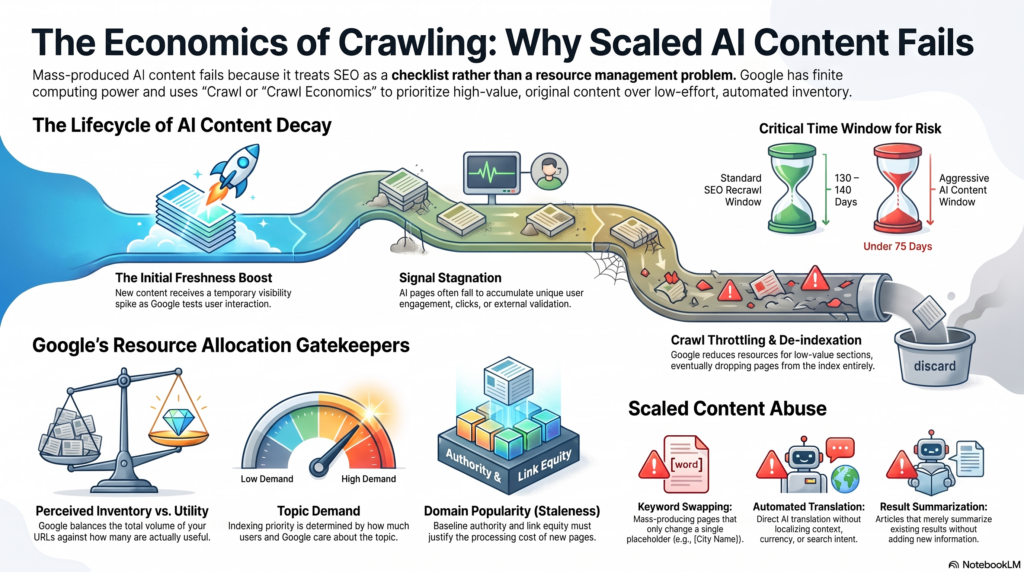
I've created this report below, which explains why automated content strategies frequently fail to achieve long-term success on Google search results. While AI-generated pages can be produced at an industrial scale, they often clash with the limited computing resources Google allocates for scanning and indexing the web. The search engine prioritizes unique value and user engagement, meaning unoriginal or repetitive automated text eventually loses its initial visibility boost. Websites that flood the internet with low-quality automation risk severe manual penalties for "Scaled Content Abuse," which can permanently damage their online reputation. Ultimately, the source argues that genuine information gain and human-centric utility are more important for ranking than simply meeting technical checklists through mass production.
What makes me different from other experts is I utilize sound business strategies like Playing To Win and Hamilton Helmer's 7 Powers Framework. It's not feel good marketing, it's proven strategies for planned outcomes.
1. The Strategic Positioning of AI Content
To achieve sustainable organic growth in the generative AI era, organizations must pivot from a "mass production" mindset to one of "resource-managed" content. Utilizing the Playing To Win framework, we define our "Where to Play" not by the sheer volume of keywords, but by high-demand topic clusters where the brand can offer verified utility. We define our "How to Win" by establishing a Content Moat through Information Gain—producing unique insights and proprietary data that competitors, currently trapped in the "mass production" phase, cannot replicate via simple prompting. This strategic shift acknowledges that search visibility is not an entitlement, but a reward for providing the highest value per unit of search engine effort.
The myth that AI is a "content cheat code" has led many enterprises into a systemic crisis. This assumption—that visibility can be treated as a checklist of title tags and H1s—fails because it ignores the technical reality of search as an infrastructure management problem. When visibility is treated as a commodity, the resulting content lacks the baseline authority and unique utility required to sustain indexation. The objective of this roadmap is to transition our operations from "Scaled Content Abuse" to "Sustainable Resource Allocation." Ultimately, success requires aligning high-level strategy with the technical reality of Google’s server costs; their infrastructure is a finite system with tangible compute limits.
2. Navigating Google’s Crawl Economics & Resource Constraints
Google’s infrastructure is a finite resource. Every page crawled and rendered represents a tangible cost in energy and data center capacity. For a systems architect, managing this "crawl budget" efficiently creates a Cornered Resource: a strategic advantage where our site’s architecture and quality signals ensure that Google’s finite resources are prioritized for our high-value URLs rather than being wasted on low-utility automation.
Google’s Resource Allocation Model
| Element | Source Definition | Strategic Impact |
| Perceived Inventory | The total volume of URLs Google believes exist versus what it deems useful. | High inventory with low utility leads to budget throttling and systemic de-indexation. |
| Demand | The level of interest users and Google have in the specific topics being published. | Content without clear demand signals is deprioritized in the crawl queue. |
| URL and Domain Popularity | Google's internal baseline of authority and link equity. Note: This is not the same as third-party tool authority metrics (e.g., DA/DR). | Dictates the processing cost Google is willing to "spend" on the domain. |
When a new programmatic initiative is launched, Google may provide an "Initial Burst-Crawl" driven by freshness signals. However, this is frequently followed by "Throttled Resource Allocation" if the system determines the inventory exceeds the domain's authority. If the quality floor is not met, Google will systematically reduce crawl frequency to protect its own compute resources. Crawl budget is the gatekeeper, but Information Gain is the currency required to pass.
3. Architecting for Information Gain and "Process Power"
Information Gain is the primary competitive moat for AI-integrated workflows. We achieve Process Power—a complex, institutionalized organizational capability—by integrating human editorial oversight into the AI workflow. This creates an output quality floor and a level of original reporting that automated competitors cannot replicate, even with the same generative tools.
To maintain visibility, content must exceed Google’s internal Quality Threshold. We must actively eliminate the "footprints of low-effort automation" described in the source context:
- Keyword Placeholder Swapping: Creating pages that simply swap terms (e.g., "Best plumbing in [City]") without providing localized, real-world utility.
- Direct AI Translation: Deploying translated content without localizing context, currency, culture, or search intent.
- Summarization Loops: Publishing articles that merely summarize existing results without contributing new data or unique reporting.
Every AI-generated page must justify its existence in the index by meeting three Strategic Requirements:
- Unique Data/Insight: It must provide information or proprietary data that cannot be generated by a model trained only on existing web data.
- Minimal Compute/Render Cost: The page must be optimized for low-compute rendering to protect the crawl budget and reduce Google's processing overhead.
- Verified Utility: The content must serve a clear user intent that justifies the energy cost of its indexation.
Failure to meet these requirements triggers a temporal decline in visibility and eventual de-indexation.
4. The Lifecycle of a URL: Managing Staleness and Decay
A significant strategic risk in AI scaling is the "Freshness Boost," which often functions as a false positive for success. This initial spike in visibility can mislead stakeholders into believing a low-value strategy is succeeding, when in reality, the system is merely testing the content against user signals.
The Decay Pipeline
- [Initial Launch] → Freshness Boost (Temporary high indexation).
- [Time Decays] → Failure to accumulate user signals or external validation.
- [Under Threshold] → Google determines the page is low-value; crawl budget is throttled.
- [Terminal Phase] → Systematic De-indexation.
We must monitor the Critical Recrawl Window (75 to 140 days). Execute a log file audit immediately for any URL cluster that has exceeded a 75-day recrawl hiatus. If Google does not return to visit a URL within this window, the content is classified as "Stale" and is at high risk of terminal de-indexation.
5. Risk Mitigation: Avoiding Scaled Content Abuse Penalties
The current landscape is defined by aggressive "Manual Actions" targeting Scaled Content Abuse. Recovering from such a penalty is not a simple fix; it represents a systemic erosion of the trust-to-compute ratio that damages the foundational integrity of the domain.
The distinction between "efficient scale" and "industrial spam" lies in the human-led quality floor. To mitigate risk, we implement the following Penalty Avoidance Checklist:
- Human-In-The-Loop Review: Every automated output must undergo human editorial review to ensure it meets quality standards and provides genuine utility as per Google's automation guidelines.
- Localized Context & Culture: Avoid direct machine translation; adapt all content for local currency, cultural nuances, and specific regional search intent.
- Original Reporting: Incorporate unique data, proprietary research, or field interviews. We must add data that cannot be generated by a model trained only on existing web data to avoid "Summarization Loops."
Long-term success is a philosophy of providing value that justifies the infrastructure signals required to sustain it.
6. Conclusion: The Sustainable Roadmap for 2026 and Beyond
Integrating AI into content workflows must align with the 7 Powers of business strategy. We prioritize Cornered Resources (unique data sets) and Process Power (superior editorial-AI workflows) to ensure our scaling efforts enhance quality rather than just volume.
Operational Priorities
- Audit Inventory vs. Authority: Ensure the volume of requested indexation does not exceed the site’s current internal popularity baseline.
- Implement Information Gain Protocols: Mandate that every new URL adds unique reporting or proprietary data to the web’s collective knowledge.
- Monitor Crawl Frequency: Use server logs to identify "Staleness" risks before pages enter the terminal de-indexation phase.
Achieving permanent indexing requires treating SEO as a resource management problem. By respecting the economics of the crawl and the cost of compute, we ensure our AI-powered content remains a strategic asset rather than a liability.