There is a growing gap between how marketers talk about AI search and how real people actually use it.
In marketing circles, AI is often discussed as if everyone is becoming a “prompt engineer.” The imagined user writes detailed, multi-paragraph prompts, carefully structured to pull the perfect answer from ChatGPT, Gemini, Perplexity, or another AI platform.
But the data tells a different story.
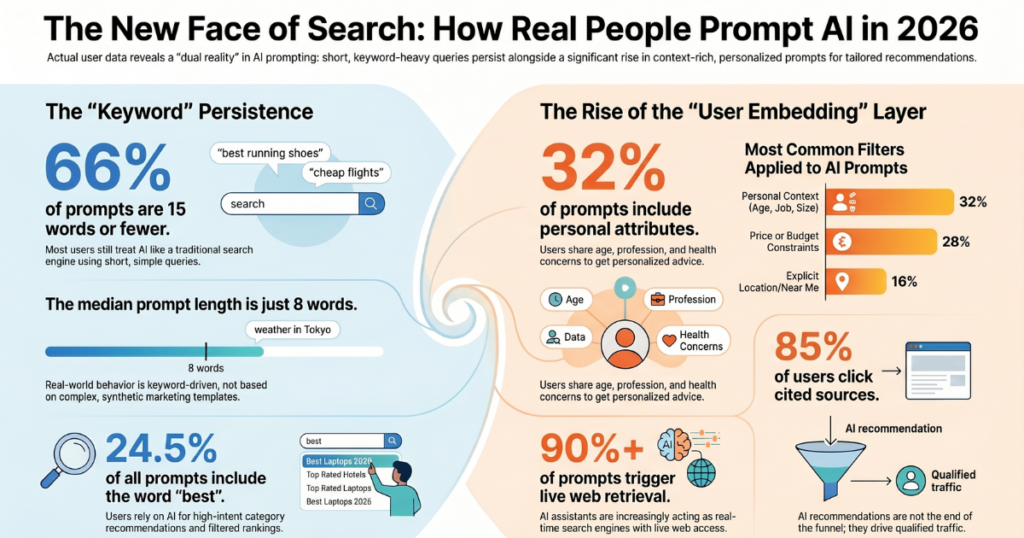
Findings from two Stella Rising surveys conducted in August 2025 and January 2026 reveal something much more practical: most people are not using AI like engineers. They are using it like search.
They ask short questions. They use familiar keywords. They look for recommendations, comparisons, prices, locations, and answers. At the same time, a growing number of users are giving AI tools more personal context than they ever gave Google.
For businesses, this creates a major strategic shift.
The future of visibility is not simply traditional SEO, and it is not only Generative Engine Optimization, or GEO. It is both. More importantly, it requires content that is genuinely useful to people.
This is the core idea behind Blue Pen’s Authority Building Through Content strategic coaching program.
SEO helps people find your content.
GEO helps AI systems understand and recommend your content.
But the real goal is not to impress Google, ChatGPT, or any other platform.
The real goal is to create content that helps people achieve their goals, solve their problems, understand their options, and trust that your business can help them.
Takeaway 1: Most People Still Search Like It’s 2008
Despite all the sophistication of large language models, most users have not abandoned their old search habits.
The influencer version of AI use often imagines long, detailed prompts. But according to the January 2026 study, two-thirds of respondents write prompts of 15 words or fewer. When users were asked to simulate a search for shoes, the median prompt was only eight words long.
That matters.
Many GEO strategies are being built around highly complex, long-form prompts. Those prompts do exist, and they matter. But they do not represent how most people currently search.
Real-world examples from the survey include:
- “Shoes nearby”
- “Nike”
- “Ladies tennis shoes size 7 near me”
- “Best price for hiking shoes”
These are not elaborate prompt-engineering exercises. They are simple search behaviors transferred into a new environment.
The “death of the keyword” has been exaggerated.
Keywords still matter because people still use them. They may be typing into an AI tool instead of a search bar, but many of the patterns are familiar: product type, location, brand, price, size, and “best.”
For businesses, the lesson is not to abandon SEO. The lesson is to make SEO more useful.
At Blue Pen, we do not view keywords as mechanical targets to be stuffed into a page. We view them as clues about human intent.
When someone searches “best price for hiking shoes,” they are not just asking for a product. They are expressing a goal. They want value. They want confidence. They may be comparing options. They may be trying not to waste money.
Good content recognizes that human need.
That is why Authority Building Through Content begins with understanding your audience, not just your keyword list. We want to know what your clients are trying to do, what questions they are asking, what problems they are trying to solve, and what would help them make a better decision.
SEO gives us the language.
Strategy gives that language a purpose.
Takeaway 2: The User Context Layer Is Changing the Rules
While many AI prompts are short, a meaningful portion of users are doing something very different.
The survey found that 32% of users provide personal context in their prompts. This creates a new layer of search behavior that traditional keyword tools cannot fully see.
Users are telling AI systems about their jobs, budgets, life stages, preferences, health concerns, social anxieties, physical needs, and personal situations. Because modern AI tools can use memory and conversation history, the recommendation is no longer based only on the current prompt. It may also be shaped by what the system knows, or thinks it knows, about the user.
This changes the visibility game.
Traditional search often focused on the query.
AI search increasingly considers the person behind the query.
One example from the survey involved a user identifying as a “Gen X person” looking for comfortable sneakers that younger people would not make fun of, within a specific budget and size.
That is not just a keyword search.
That query contains age, style anxiety, social context, price sensitivity, physical comfort, and personal identity. It reveals the emotional and practical layers behind the purchase.
This is where generic content fails.
A bland product page or service page may mention features, but it often misses the deeper human concern. It may answer, “What do we sell?” but fail to answer, “Do we understand what this person is really trying to solve?”
That distinction is central to Blue Pen’s work.
Authority Building Through Content helps businesses turn their real expertise into content that speaks to both visible and hidden intent. We help clients write content that shows they understand the practical problem, the emotional concern, and the decision-making process their audience is going through.
This matters for SEO.
It matters for GEO.
But most of all, it matters for trust.
When AI systems synthesize answers, they are looking for content that can be understood, summarized, and recommended. If your website clearly explains who you help, what problems you solve, what situations you understand, and what makes your approach useful, you become easier to retrieve and easier to recommend.
The goal is not to manipulate the AI.
The goal is to make your expertise clear enough that both people and AI systems can understand why you are relevant.
Takeaway 3: People Are Beginning to Trust AI Recommendations
The survey found that 68% of users trust ChatGPT’s recommendations more than Google’s.
That is a major shift.
This trust appears to be driven by several factors:
- AI feels less cluttered by ads.
- AI provides synthesized answers instead of a long list of links.
- AI can personalize recommendations based on context.
For businesses, this creates both opportunity and risk.
The opportunity is that AI-referred visitors appear to be highly valuable. The research indicates that AI-referred visitors convert at 4.4x the rate of standard organic traffic.
The risk is that AI referral traffic is still small. It currently accounts for only 1.08% of total web traffic.
In other words, AI search is not yet replacing all other channels. But it is already producing unusually high-value traffic.
That means businesses should not panic, and they should not ignore it.
They should prepare.
This is exactly where a combined SEO and GEO strategy becomes important. Traditional SEO still supports discoverability. GEO helps your content become more usable in AI-generated answers. Together, they create a stronger foundation for long-term visibility.
But again, the purpose is not merely traffic.
Traffic alone does not build a business.
The right content attracts the right audience. It helps people understand their problem more clearly. It explains why your expertise matters. It builds confidence before the first phone call, form submission, purchase, or consultation.
That is why Blue Pen’s Authority Building Through Content program is not just a content production service. It is a strategic coaching process.
We help clients identify the knowledge inside their organization and turn it into useful, discoverable, trust-building content. That may include blog posts, service pages, educational articles, FAQs, product descriptions, email content, or other digital assets.
The format can vary.
The goal stays the same: create content that helps people move from confusion to clarity, and from clarity to action.
Takeaway 4: Voice Search and Local Intent Are Moving Into AI
After years of hype, voice search appears to be reaching a more meaningful stage.
The survey found that 34% of users are now using voice chat with AI daily. It also found that 16% of prompts are explicitly location-based.
This means that the familiar “near me” behavior from mobile search is moving into AI environments.
For local businesses, this matters enormously.
AI Overviews now appear on 92% of informational local queries, and the presence of an AI Overview correlates with a 58% lower clickthrough rate for the top-ranking organic page.
That means the user may get the answer they need without ever clicking through to a website.
For local businesses, the concern is not only ranking lower. The concern is being left out of the answer entirely.
If an AI system summarizes the best options in a local market, will your business be included?
Will it understand what you do?
Will it know who you serve?
Will it be able to explain why you are a good fit?
This is not just a technical SEO issue. It is a content clarity issue.
Many businesses have websites that are too vague. Their service pages are thin. Their local relevance is underdeveloped. Their expertise is assumed rather than explained. Their content does not clearly connect their services to the real problems their customers are trying to solve.
In traditional search, that was already a weakness.
In AI search, it becomes even more costly.
GEO rewards clarity. AI systems need content they can interpret, summarize, and confidently connect to a user’s question. If your website does not clearly explain your services, audience, geography, expertise, and value, you make it harder for AI to recommend you.
Blue Pen helps clients solve that problem by building content ecosystems, not just isolated posts.
A strong content strategy might include:
- Service pages that clearly explain what you do and who you help.
- Blog posts that answer the real questions your audience asks.
- Local content that connects your expertise to your market.
- Educational articles that build authority over time.
- Practical explanations that help people make better decisions.
This is how SEO and GEO serve business goals.
They help your business become findable, understandable, and credible.
Takeaway 5: SEO Keywords Still Matter Because AI Still Retrieves the Web
One of the biggest misconceptions about AI search is that it makes traditional SEO irrelevant.
The data does not support that.
According to the research, over 90% of monitored prompts trigger live web retrieval. That means AI systems are often still searching the web in real time before generating an answer.
And when users enter short, SEO-shaped prompts, which still account for roughly 30% of prompts, the AI often behaves like a search engine that synthesizes instead of simply listing results.
This means your content still needs to be retrievable.
The survey also identified specific keyword patterns that remain important:
- 24.5% of prompts include the word “best.”
- 28% of prompts explicitly mention price or budget constraints.
That should get every business owner’s attention.
People still want recommendations. They still compare options. They still care about cost. They still ask who is best, what is worth it, what is nearby, and what fits their situation.
The difference is that AI may now answer those questions directly.
To be included in that answer, your content needs to be both search-ready and synthesis-ready.
Search-ready content can be found.
Synthesis-ready content can be understood and recommended.
That is the bridge between SEO and GEO.
Blue Pen’s Authority Building Through Content program helps clients build that bridge. We work with businesses to develop content that reflects their expertise, speaks in the language of their audience, answers meaningful questions, and gives search engines and AI systems clear signals about relevance.
But we do not start with the algorithm.
We start with the business goal.
Do you need to attract better-fit clients?
Do you need to explain a complex service?
Do you need to build trust in a niche market?
Do you need to support a sales process?
Do you need to become more visible in a local region?
Do you need to help potential clients understand why your approach is different?
Those questions shape the content strategy.
SEO and GEO then help that strategy reach the people it was built to serve.
Conclusion: The Future of Search Belongs to Useful Content
The future of search is not a choice between SEO and GEO.
Businesses need both.
SEO remains essential because people still search with keywords, and AI systems still retrieve information from the web.
GEO is becoming essential because AI systems increasingly synthesize answers, personalize recommendations, and shape what users see before they ever visit a website.
But neither SEO nor GEO should be the real center of your content strategy.
People should be.
Your audience is trying to do something. They are trying to solve a problem, make a decision, compare options, reduce risk, understand a service, or find someone they can trust.
Your content should help them do that.
That is the purpose of Authority Building Through Content.
At Blue Pen, we help clients turn their expertise into content that is useful, discoverable, and strategically aligned with their business goals. We use SEO so people can find it. We use GEO so AI systems can understand and recommend it. But we write for humans first, because humans are the ones making decisions.
The prompt engineering myth assumes the future belongs to people who know how to talk to machines.
The better lesson is this:
The future belongs to businesses that know how to communicate clearly with people.
If your content helps people understand their needs, trust your expertise, and take the next right step, then SEO and GEO become more than marketing tactics.
They become tools for building authority, visibility, and long-term business value.