Imagine someone asking an AI assistant:
- “Who is the best attorney near me for this type of case?”
- “Which choral publisher specializes in music for developing tenor-bass choirs?”
- “What pharmaceutical company is researching this condition?”
- “Which local business can solve this problem?”
- “What consultant understands the challenges facing a family-owned company?”
The AI responds with a concise recommendation—perhaps mentioning only two or three organizations.
There may be no traditional search-results page, no ten blue links and no guarantee that the user will visit every company’s website. The artificial intelligence system researches the options, evaluates their apparent credibility and presents the answer.
The important question is no longer simply, “Can customers find your website?”
It is now:
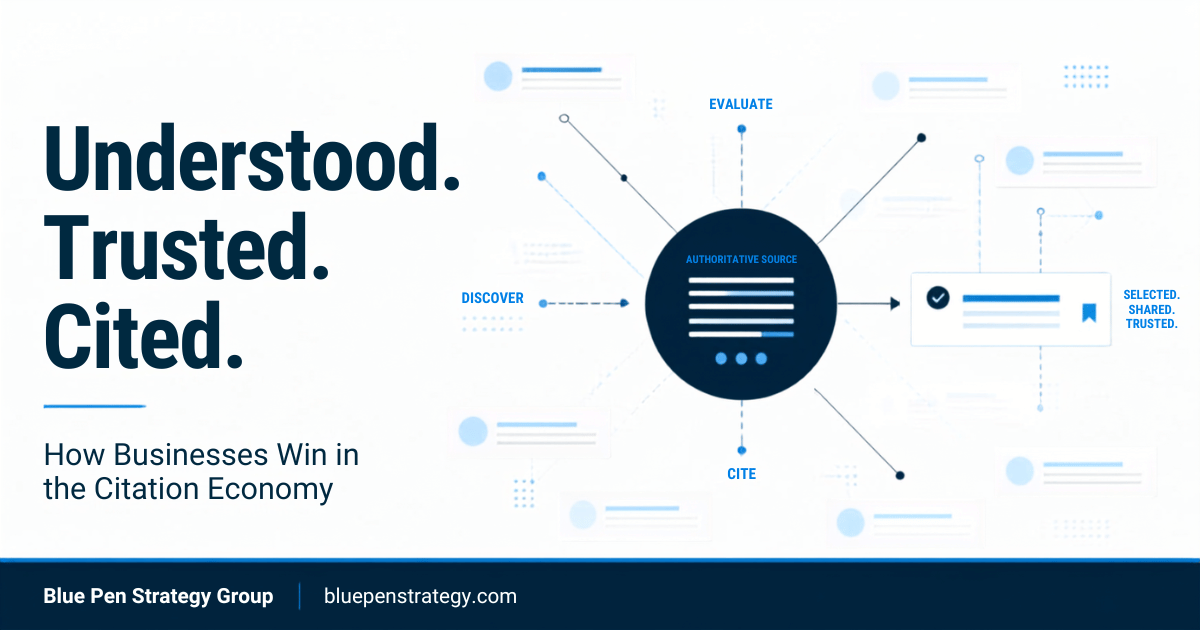
Does the search engine or AI system understand your business, trust your expertise and consider your organization worthy of being cited?
That is the emerging citation economy.
Traditional search engine optimization remains important. Google itself says that established SEO practices continue to provide the foundation for visibility in AI Overviews and AI Mode. But rankings and website traffic are no longer the complete measurement of digital visibility. Businesses must also prepare their content for generative engines such as ChatGPT, Google Gemini, Microsoft Copilot, Perplexity and the AI tools that will increasingly research products, services and professional expertise on a customer’s behalf.
To compete in this environment, a business must accomplish three things:
- Be understood.
- Be trusted.
- Be cited.
Search Is Becoming an Answer Engine
For years, digital marketing followed a relatively predictable path:
- A potential customer entered a search.
- Google displayed a list of links.
- The customer selected a website.
- The website persuaded the customer to act.
That journey is changing.
During the first four months of 2026, 68.01% of U.S. Google searches ended without a click to another website, according to SparkToro research based on Similarweb clickstream data. Google also reported that AI Overviews had grown to more than 2.5 billion monthly users by the time of Google I/O 2026.
People are increasingly receiving information directly from the search results or an AI-generated response. This does not mean websites have become irrelevant. It means the website now serves two audiences:
- The person who visits the page
- The search or AI system deciding whether to use, summarize or recommend the information
A company can therefore influence a customer without receiving an immediate click. When an AI assistant names a business, quotes its expertise or uses its information to formulate an answer, the company gains visibility and authority inside the response itself.
That is why citations, mentions and recommendations are becoming as important as rankings.
Step One: Your Business Must Be Understood
Before a search engine or generative AI system can recommend a business, it must understand what the business is, what it does and how its people, services, products and areas of expertise relate to one another.
A website may look perfectly clear to a human while remaining ambiguous to a machine.
For example, a publishing company may use its formal corporate name on one page, an imprint name on another and an abbreviation in its social profiles. A law firm may describe the same practice area with several different terms. A family business may have multiple locations with outdated addresses scattered across online directories.
Each inconsistency makes it harder for a system to establish a confident picture of the organization.
Create a consistent business identity
The organization’s name, services, leadership, location and areas of expertise should be described consistently across:
- The company website
- Google Business Profile
- Professional and industry directories
- Social media profiles
- Press releases
- Review platforms
- Product listings
- Author and employee biographies
This consistency helps search engines connect scattered references to the same business entity.
If a company is called “Hinshaw Music” on its website, for example, it should not alternate unpredictably among “Hinshaw,” “Hinshaw Music Co.” and other variations without explaining how those names relate.
Give every page a clear purpose
Pages should use descriptive headings and organize information around recognizable questions or topics. This improves readability for people while helping search and AI systems identify individual facts and relevant passages.
A strong page should make it easy to determine:
- Who created the content
- What organization published it
- What question the page answers
- Which product, service, person or topic it discusses
- When the information was published or updated
- Where the business operates
- What the reader should do next
Use structured data appropriately
Structured data, commonly called schema markup, adds machine-readable labels to a webpage. These labels can identify information such as:
- An organization
- A local business
- A person or author
- An article
- A product
- An event
- A frequently asked question
Google describes structured data as a tool it uses to understand webpage content and the people, products, companies and other entities represented on a page. Companies have also reported substantial improvements in traditional search performance. Rotten Tomatoes measured a 25% higher click-through rate on pages enhanced with structured data, while Nestlé reported an 82% higher click-through rate for pages appearing as rich results, according to Google Search Central’s structured-data case studies.
Schema does not guarantee an AI citation, and Google states that no special structured data is required specifically for its generative AI features. Nevertheless, accurate schema remains an important part of a well-organized SEO strategy because it gives search engines clearer information and can make pages eligible for enhanced search results.
Think of it as placing accurate name tags on the important elements of your website.
Step Two: Your Business Must Be Trusted
Being understood is not the same as being believed.
A search engine may recognize that a website discusses pharmaceutical research, copyright law, choral composition or succession planning. It must still decide whether the information is reliable enough to present to someone else.
That is why anonymous, generic content is increasingly ineffective—particularly in industries where expertise, accuracy and accountability matter.
Put a real expert behind the content
Articles should identify the person who wrote or reviewed them whenever appropriate. An author page can include:
- The author’s full name
- Professional role
- Education or credentials
- Relevant experience
- Professional affiliations
- Other publications or presentations
- Links to authoritative external profiles
“Written by Admin” tells readers and machines almost nothing.
An article written or reviewed by an experienced attorney, composer, publisher, clinician, researcher, executive or family-business advisor creates a much stronger credibility signal.
Demonstrate firsthand knowledge
The most useful content adds something that cannot be produced by summarizing the first ten search results.
That might include:
- An attorney explaining a recurring misconception encountered in practice
- A composer discussing the musical choices behind a new choral work
- A publisher explaining how repertoire is selected and prepared
- A pharmaceutical company presenting transparent research findings
- A start-up sharing results from actual product testing
- A family business documenting lessons from a leadership transition
Google’s current guidance emphasizes creating unique, expert-led, non-commodity content rather than producing material solely to manipulate search or AI results. The goal is not simply to publish more. It is to publish something worth using.
Support factual claims
Important claims should be supported by reliable sources, internal data, original research or documented experience.
Citations show that the organization has done its homework. They also help readers—and AI systems—distinguish grounded expertise from unsupported marketing language.
Trust is built when the company’s website, external profiles, customer reviews, media coverage and real-world reputation reinforce the same story.
Step Three: Your Business Must Be Cited
Citation is the payoff.
Your organization does not merely appear somewhere in a list of results. It becomes part of the answer.
That may mean an AI system:
- Names the company as a relevant provider
- Quotes or summarizes an article
- Recommends a product
- Identifies one of the company’s professionals as an expert
- Uses the organization’s research to support an explanation
- Includes the business in a local or industry-specific comparison
Answer real questions clearly
Pages should directly address the questions customers ask before making a decision.
A useful answer usually begins with a clear response and then provides supporting explanation, qualifications, examples and evidence. Readers should not have to search through several paragraphs of promotional language to find the central point.
This does not require writing robotic content for machines. In fact, Google specifically cautions against creating awkward content merely to target every possible keyword variation. Clear, natural and well-supported writing serves both human readers and generative search systems.
Build authority beyond your own website
Every organization says favorable things about itself. Independent references carry different weight.
Research from Ahrefs involving 75,000 brands found that branded web mentions had a much stronger correlation with visibility in Google AI Overviews than traditional backlinks—0.664 compared with 0.218. A subsequent Ahrefs analysis found that YouTube mentions had an approximately 0.737 correlation with visibility across ChatGPT, Google AI Mode and AI Overviews. Correlation does not prove that mentions directly cause inclusion, but the findings demonstrate the growing importance of a brand’s broader digital presence. (Ahrefs brand visibility research)
Depending on the organization, meaningful third-party visibility may include:
- Industry publications
- Professional associations
- News coverage
- Interviews and podcasts
- YouTube videos
- Conference presentations
- Customer reviews
- Academic references
- Expert roundups
- Relevant community discussions
This is not an invitation to manufacture mentions or spam online communities. Authentic recognition is valuable because it provides independent evidence that the organization is associated with a particular subject.
The goal is to become the obvious expert in a clearly defined area—not a generic source producing superficial content about everything.
Why AI-Referred Visitors Deserve Attention
AI-generated answers may reduce some informational clicks, but the visitors who do follow an AI recommendation can arrive with unusually strong intent.
Adobe reported that traffic to U.S. retail websites from generative AI sources increased 693% year over year during the 2025 holiday season. AI-referred visitors also converted 31% more effectively than traffic from other sources, according to Adobe’s analysis of AI-driven traffic.
Why might this traffic be more valuable?
The AI system may have already:
- Interpreted the customer’s need
- Researched the available options
- Compared relevant features
- Answered initial questions
- Eliminated less suitable choices
- Explained why a particular company or product fits
In effect, the AI begins to act like a researcher, referral partner or procurement assistant. When the customer finally reaches the website, much of the early decision-making process may already be complete.
This is why raw traffic cannot be the only measure of success. Businesses must also examine qualified inquiries, branded searches, mentions, conversions and their visibility inside AI-generated answers.
Why Should a Business Owner Know Any of This?
You need to understand this shift because it affects how future customers discover, evaluate and select your business.
But understanding its importance does not mean you should personally manage every part of it.
If you are an attorney, your time is better spent advising clients and practicing law.
If you are a composer, your best work happens when you are composing, conducting and connecting with performers.
If you are a publisher, you should be discovering, developing and distributing exceptional work.
If you lead a pharmaceutical company, your attention belongs on research, compliance, safety and bringing effective treatments to market.
If you run a start-up, you should be building the product, serving customers and finding a sustainable path to growth.
If you operate a family business, you should be taking care of customers, employees and the long-term health of the company.
You should know enough to recognize that digital visibility has changed. You should be able to ask informed questions and understand what is at stake.
You should not have to become an expert in technical SEO, structured data, content architecture, digital public relations, author authority, entity consistency, local search and generative engine optimization while also running your organization.
Let Blue Pen Strategy Group Take Responsibility for the Work
Blue Pen Strategy Group helps organizations turn their real-world expertise into a digital presence that search engines, AI systems and—most importantly—potential customers can understand and trust.
That responsibility can include:
- Clarifying how the organization and its services are described
- Developing useful, expert-led website content
- Strengthening technical and on-page SEO
- Implementing appropriate structured data
- Creating consistent author, product and company information
- Building a practical SEO and generative engine optimization strategy
- Identifying opportunities for credible external visibility
- Monitoring what customers and AI systems encounter when researching the brand
- Connecting digital visibility to meaningful business goals
The purpose is not to chase every new platform or promise a shortcut into an AI-generated answer. No ethical strategist can guarantee that a search engine or AI system will cite a particular company.
The purpose is to build the strongest possible foundation for discovery, understanding, trust and recommendation.
Your responsibility is to lead your organization and do the work that only you can do.
Ours is to make sure the people—and the increasingly intelligent systems—looking for that work can find it, understand it and confidently point others toward it.
The Question Every Organization Should Ask
If your website disappeared tomorrow, would search engines and AI systems still understand who you are, what you do and why your organization matters?
Would credible sources still connect your name with your area of expertise?
Would an AI assistant know enough—and trust the available information enough—to recommend you?
Or would your business become a ghost in the digital landscape?
In the citation economy, being online is not enough.
Your organization must be understood, trusted and cited.
Blue Pen Strategy Group helps businesses build the digital authority required for all three.