Why music publishers, therapists, and attorneys should measure content marketing by the customers it attracts—not simply the traffic it generates.
Imagine two articles published on your company's website. The first attracts 10,000 visitors. People read it, share it, and move on. A handful eventually contact your business. The second attracts just 500 visitors. Yet 25 of those visitors contact you to inquire about your products or services. Which article is more successful?
If you're measuring success by website traffic, the first article wins. If you're measuring success by meaningful business opportunities, the second article tells a much more interesting story.
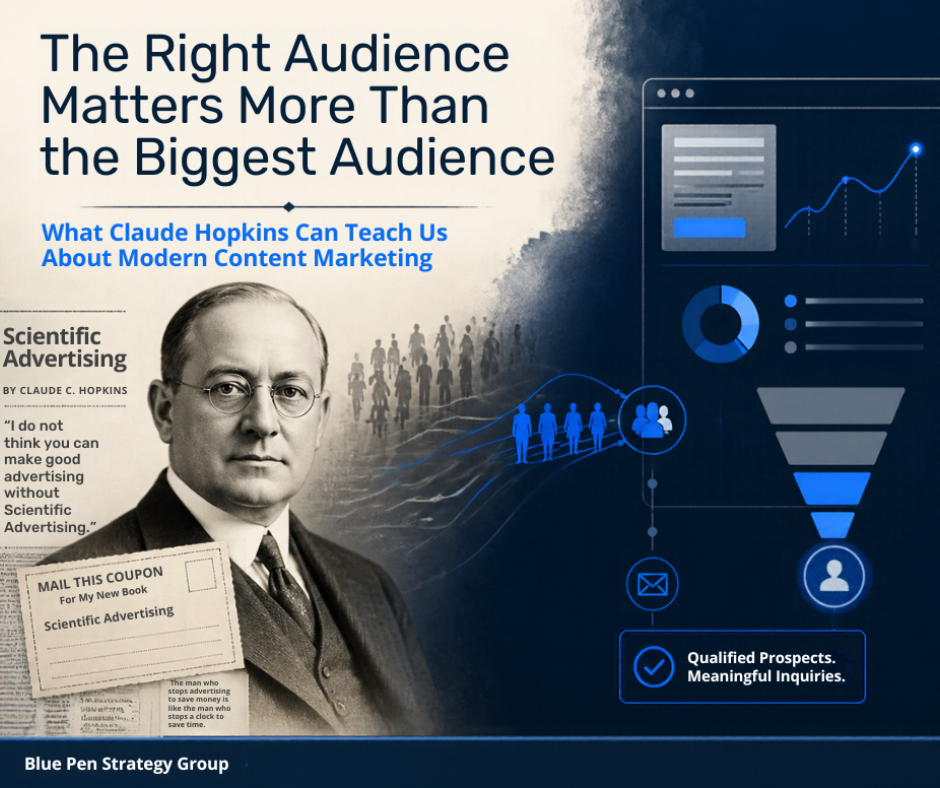
More than a century ago, advertising pioneer Claude C. Hopkins understood this distinction. His ideas, outlined in his influential 1923 book Scientific Advertising, offer an important lesson for modern businesses: Marketing should be judged not simply by how many people it reaches, but by whether it reaches the right people and inspires meaningful action.
For music publishers, therapists, attorneys, and other professional-service businesses, this principle can fundamentally change how we think about content marketing.
Claude Hopkins and the Science of Advertising
Claude Hopkins was an advertising executive who helped establish the idea that advertising should be tested, measured, and improved rather than guided entirely by intuition or creative preference. At a time when advertisers often emphasized memorable slogans and broad public exposure, Hopkins argued that advertising should be evaluated according to its commercial effectiveness. He treated advertising as a form of salesmanship.
Hopkins used the tools available in his day, including coded coupons, response tracking, and comparisons between advertising approaches. By examining which advertisements generated responses and sales, he could identify what worked and refine future campaigns. Not all responses were equally valuable: an advertisement generating numerous inquiries might be less effective than one attracting fewer but more qualified prospective customers.
Content Marketing Isn't a Popularity Contest
Many businesses evaluate content using website visits, social media likes, video views, search rankings, and time spent reading articles. These metrics are useful indicators of visibility and behavior, but they don't necessarily tell us whether content contributes to business growth.
An article can attract thousands of readers without reaching a single serious prospective customer. Conversely, an article with modest traffic may consistently attract people actively searching for exactly what a business offers. The objective isn't simply more traffic. It's qualified traffic—people whose interests, questions, and needs align with the products or services a business provides.
Content Marketing for Music Publishers: Reaching the Right Conductors
Consider a music publisher specializing in choral repertoire. An article about the history of choral music might attract thousands of students, historians, musicians, and enthusiasts. That visibility has value. But consider a more targeted article: “How to Choose SATB Repertoire for a Small Church Choir with Limited Rehearsal Time.”
That article addresses a specific problem faced by a specific audience. A choir director searching for suitable repertoire may be preparing to purchase music for an upcoming season. If the article offers practical guidance about vocal ranges, difficulty levels, and appropriate repertoire, it helps the conductor while introducing the publisher's catalog at a relevant moment.
If the publisher can identify which educational articles lead readers to product pages, score previews, digital samples, and purchases, it can learn which musical challenges and programming needs are associated with purchasing behavior. That intelligence can guide future articles, catalog organization, promotional campaigns, and even repertoire development. Content becomes a source of customer intelligence.
Content Marketing for Therapists: Building Trust Before the First Appointment
People seeking therapy often begin by researching a concern rather than searching for a particular provider. Someone experiencing anxiety may search for information about persistent worry, workplace stress, or difficulty sleeping. A parent may look for guidance on supporting a teenager who is struggling emotionally.
Consider an article titled “Why Does Anxiety Feel Worse at Night? Understanding Common Causes and Coping Strategies.” Some readers may simply be curious. Others may be considering professional support. With appropriate analytics, a practice can evaluate whether visitors arriving through that article subsequently explore therapy services, review qualifications, or request appointments.
These patterns can reveal which educational subjects are associated with interest in the practice. This is not about identifying individual readers or tracking sensitive mental health concerns. Therapists should use privacy-conscious analytics, avoid sending sensitive personal information to marketing tools, and respect applicable professional and legal obligations. The goal is to understand aggregate behavior and improve the usefulness of information offered.
Effective content marketing for a therapy practice is not about turning every reader into a patient. It's about providing credible information and ensuring that people seeking professional assistance can find an appropriate next step.
Content Marketing for Attorneys: Demonstrating Expertise When Clients Need Answers
People often begin their search for legal representation with a question about a problem. A business owner may want to understand the difference between an LLC and a corporation. An employee may research workplace rights. A family may need to understand probate after losing a loved one.
Consider an estate-planning attorney who publishes “What Happens If Someone Dies Without a Will in California?” Some readers may be curious; others may be confronting an immediate family situation and considering legal assistance. If visitors arriving through that article frequently explore probate services or request consultations, the attorney gains insight into questions associated with prospective clients.
That knowledge can guide related articles about probate timelines, estate administration, or executor responsibilities. Over time, the website becomes an educational resource that also attracts people with genuine legal needs. Legal content must be accurate, jurisdiction-specific where appropriate, and consistent with attorney advertising and professional responsibility rules. Reading an article should not imply an attorney-client relationship.
Google Analytics: The Modern Equivalent of Hopkins's Response Tracking
Hopkins used coupons and other response mechanisms to understand which advertisements motivated customers. Today, Google Analytics 4 can help businesses examine landing pages, traffic sources, visitor journeys, and tracked events such as contact form submissions, consultation requests, and purchases.
The question shifts from “How many people read our content?” to “Which content attracts people most likely to need what we offer?” A contact form submission does not necessarily mean a qualified lead, and a phone-link click does not prove that a conversation occurred. Analytics cannot perfectly reconstruct every customer's journey. For stronger measurement, businesses should combine website analytics with appropriate lead qualification, sales records, or CRM data.
From Content Creation to Customer Intelligence
Publishing an article should not be the end of the process. It should begin a cycle of learning. A business identifies questions that matter to prospective customers, publishes useful content, and measures audience response. Some subjects attract traffic but little commercial interest; others attract smaller audiences that consistently generate inquiries, consultations, or purchases.
For music publishers, these findings may reveal interest in repertoire for particular ensembles. For therapists, they may reveal educational subjects that lead visitors to explore services. For attorneys, they may identify legal questions that frequently precede consultation requests. Content marketing becomes a systematic way to learn what prospective customers care about, demonstrate expertise, and improve the connection between a business and the people it serves.
Why SEO, AEO, and GEO Matter to This Strategy
Traditional search engine optimization (SEO) remains important, but people increasingly discover information through AI-powered search results, answer engines, and generative AI assistants. Answer Engine Optimization (AEO) emphasizes direct answers to questions; Generative Engine Optimization (GEO) focuses on content that generative systems can understand and reference. These approaches overlap and share an objective: make credible, useful information easy to discover and interpret.
For specialized businesses, clear answers to genuine audience questions are an opportunity. Content should be accurate, organized with descriptive headings, supported by appropriate expertise and citations, and published on an accessible website. Authorship information and suitable structured data can help search systems interpret it, but no technique guarantees placement in AI-generated answers or citations.
Appearing in an AI answer is not itself the ultimate business objective. The goal remains attracting relevant people and creating meaningful opportunities for them to engage with the business.
Frequently Asked Questions About Content Marketing
What is the most important metric for content marketing?
The most important metrics depend on business objectives, but qualified leads, customer acquisition, sales, and revenue are generally more meaningful commercial indicators than page views alone. Traffic and engagement help explain how content contributes to those outcomes.
Can content marketing work with low website traffic?
Yes. A specialized business can generate meaningful opportunities from a relatively small audience if its content reaches people with relevant needs and purchasing intent.
How can Google Analytics help measure content marketing?
Google Analytics 4 can show landing pages, traffic sources, and tracked actions. Properly configured, it helps identify content associated with inquiries, purchases, and other outcomes.
How does content marketing build professional authority?
Content marketing demonstrates expertise through useful explanations, relevant questions, and substantive guidance. It helps prospective clients evaluate professional knowledge before making contact.
How are SEO, AEO, and GEO related to content marketing?
SEO supports discoverability in search engines; AEO emphasizes direct answers; GEO emphasizes usefulness and interpretability in generative AI discovery. All benefit from accurate, well-structured, audience-focused information.
The Real Goal: Better Customers, Not Just Bigger Numbers
Claude Hopkins understood something that remains essential more than a century later: marketing should accomplish something meaningful. It should help people understand why a product or service matters, reach those most likely to benefit, and be evaluated using evidence rather than assumptions.
Today we can publish content that answers real questions, examine which subjects attract prospective customers, identify patterns in their behavior, and continually refine our approach. For music publishers, therapists, attorneys, and other specialized businesses, that's far more valuable than simply producing more articles or chasing higher traffic numbers.
The goal isn't to reach everyone. It's to reach the people who matter to your business, give them information worth their attention, and earn the opportunity to serve them. That's not just good content marketing. It's good business.
About Blue Pen Strategy Group
At Blue Pen Strategy Group, we believe effective content marketing begins with the knowledge and expertise our clients already possess. Our Authority Building Through Content approach helps businesses and professionals transform that expertise into useful, discoverable content designed to reach relevant audiences, establish credibility, and create meaningful business opportunities.
We combine content strategy, digital marketing, search visibility, and performance analysis to help clients move beyond publishing for its own sake. Because the measure of a successful content strategy isn't simply how many people see it. It's whether the right people find it—and what happens next.